
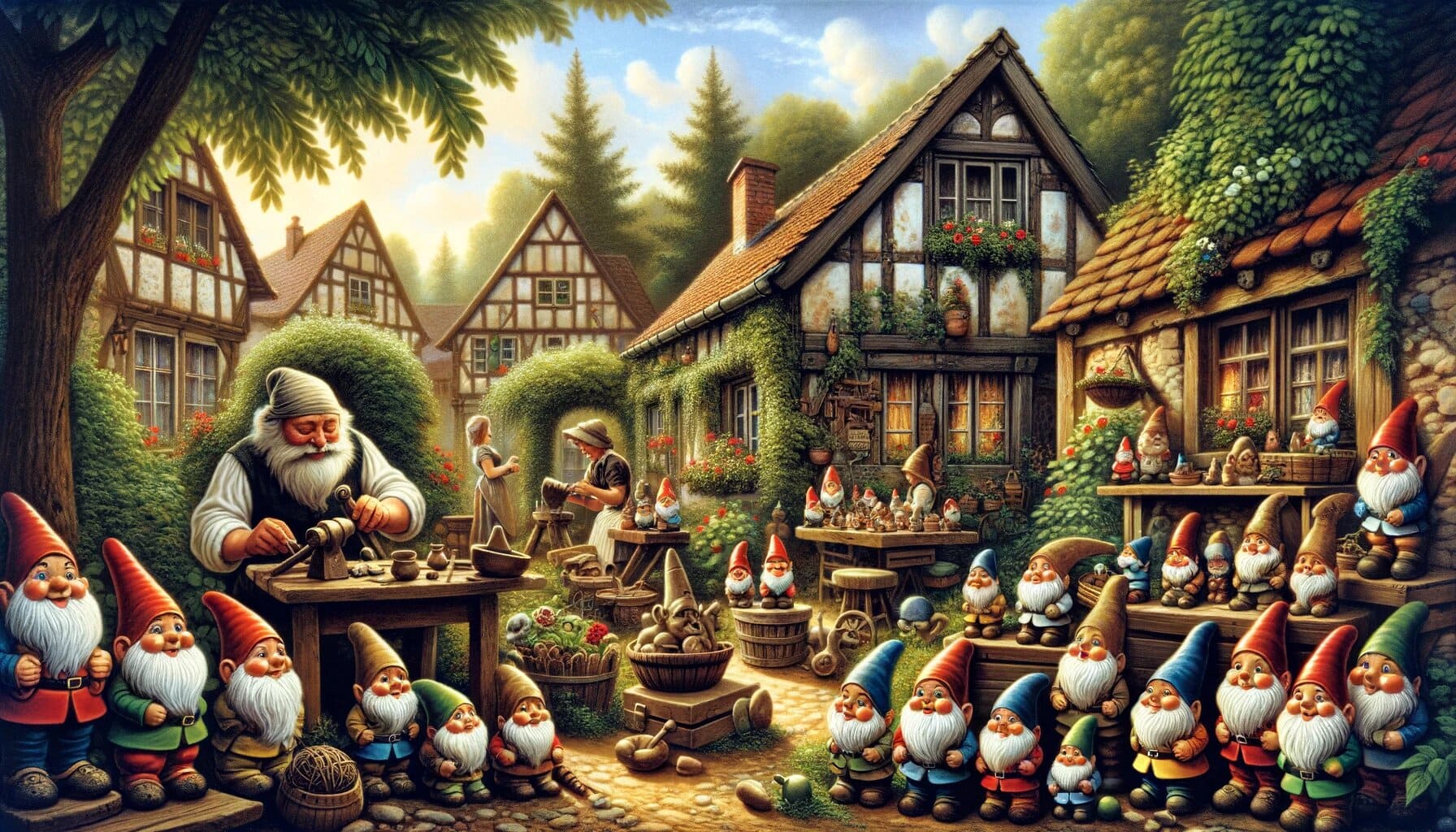
The garden is important in many ways. It is an oasis of tranquility where you can relax without having to leave your home, and it is more than ever an extension of your home. Therefore, it is important to design the garden so that it is comfortable and soothing and invites relaxation. This includes, of course, garden furniture, a beautiful parasol, a fire pit, or a heated parasol for cool summer evenings, and, of course, decoration. And when you talk about decoration and gardens, you are surely also talking about the indispensable garden gnome! The garden gnome is more than just an accessory; it is the preferred companion of green spaces. It brings both imagination and originality to a lawn and adds color to your everyday life. But where does the garden gnome come from? What is its story?
The History of the Garden Gnome: Surprising Origins
This little man made of terracotta or resin first appeared during the Renaissance. Its origins date back to the time when pygmies were employed in the precious metal mines of Cappadocia in the 15th century. Workers, who were represented by small wooden figurines that were supposed to protect them from the evil forces of the underworld. These people were sometimes equipped with a straw-filled hat to reduce damage from possible landslides, and wore brightly colored clothing to be more easily seen in the darkness of the underground. Experts claim that the first garden gnomes appeared between 1690 and 1695. Today, these marble sculptures can be admired at Mirabell Palace in Salzburg, Austria. By the way, they are the work of a certain Johann Bernhard Fischer von Erlach.

The Story of the Garden Gnome: A Real Plebiscite!
Originally intended as an amulet to protect minors, garden gnomes were gradually democratized after some changes. The success was, by the way, rapid. In Germany, production was industrialized to meet the very high demand. The garden gnomes were now made of ceramic. They were also referred to as goblins. The term "garden gnome" came later. The Englishman Sir Charles Isham was responsible for the worldwide spread of the figurines. After falling in love with this new phenomenon, he brought about 20 specimens to Lamport Hall to place them in his garden. While the regions around Germany gradually succumbed to the garden gnome craze, the cheerful little creatures were not to be missed in England either. Even the writer Goethe quoted garden gnomes in his work Hermann and Dorothea. Proof that they were already indispensable back then.
The History of the Garden Gnome: Popular Culture
Goethe may have been one of the first artists to talk about garden gnomes, but he was not the last. In the following period, garden gnomes became true icons of popular culture. The success of Snow White and the Seven Dwarfs, Walt Disney's first animated film, is associated with garden gnomes. Are Snow White's friendly companions not an exact copy of the little garden statues? A work that helped give the garden gnome a sympathetic image. Nowadays, the specimens are sold by the row all over the world. Among the other works that have made use of garden gnomes is The Fabulous Destiny of Amélie Poulain. Do you remember the traveling gnome that was photographed in front of some of the most beautiful places in the world! He too found many imitators! One look at Instagram is enough to be convinced of that. Even years after the release of the feature film. Finally, there is the children's film Gnomeo and Juliet, which adapts Shakespeare's Romeo and Juliet, or the fantasy film Chair de Poule, in which garden gnomes come to life.
The Story of the Garden Gnome: A Love-Hate Relationship
The success of garden gnomes has always been undisputed, but the figurines do not only have fans. Over the years, garden gnomes have even become a symbol of kitsch for some. Some love them, others hate them. There are even cases of broken garden gnomes and their image is regularly distorted. Nevertheless, the garden gnome has never left anyone indifferent, and that is probably its strength. Whether you love it or react allergically to it, its significance can hardly be denied.

The History of the Garden Gnome: Its Development
Over the years, and especially due to the increasingly hectic production rhythm to satisfy all consumers, the garden gnome had to evolve further. For this reason, you find fewer and fewer terracotta garden gnomes. Modern" garden gnomes are increasingly made of resin, cast concrete, or even plastic. These materials are more resistant and practical. Their appearance has also evolved. You can find all kinds of garden gnomes: realistic ones that closely resemble the seven dwarfs from Snow White, creepy ones that look as if they came straight out of a Halloween fairy tale, surfing, humorous, weird gnomes... The garden gnome encourages all eccentricities! Did you know that a garden gnome that once belonged to Sir Charles Isham himself was valued at over one million euros? Proof that the garden gnome is still popular. The existence of a front to free the garden gnomes, which has made it its mission to free as many garden gnomes as possible, is further proof. These little creatures still have many beautiful days ahead of them. As guardians of our gardens, they watch over the grain with goodwill and are not about to go out of fashion!